Fabric is more than just the clothes on our back or the curtains in our window. It is a fundamental thread woven into the very fabric of human civilization. From the earliest hand-spun fibers that protected us from the elements to the cutting-edge smart textiles monitoring our health, fabrics tell a story of innovation, culture, art, and survival. They are a testament to our ingenuity, a canvas for our creativity, and a daily companion in our lives. This comprehensive guide will take you on a journey through the vast and intricate world of textiles, exploring their origins, their properties, their creation, and their future.
Part 1: The Foundation – Understanding Fibers
The journey of any fabric begins with its most basic component: the fiber. A fiber is a hair-like strand that is the fundamental building block of yarn, which is then constructed into fabric. Fibers can be classified into three primary categories: Natural, Regenerated, and Synthetic.
1.1 Natural Fibers
Natural fibers are derived from plants, animals, or geological processes. They are biodegradable and have been used for millennia.
Plant-Based (Cellulosic) Fibers:
- Cotton: The world’s most popular natural fiber. Cotton is soft, breathable, absorbent, and hypoallergenic, making it ideal for everyday clothing, bed linens, and towels. However, it can wrinkle easily and shrink if not pre-treated. Conventional cotton farming is also notoriously water-intensive and pesticide-heavy, leading to the rise of more sustainable options like organic and recycled cotton.
- Key Varieties: Pima and Egyptian cotton are known for their extra-long staples (fiber length), resulting in stronger, softer, and more lustrous fabrics.
- Linen: Made from the flax plant, linen is one of the oldest known textiles. It is incredibly strong, highly absorbent, and has excellent breathability, making it a favorite for hot and humid climates. Its characteristic crisp texture and slight slubs give it a distinct, rustic elegance. The main drawback is its propensity to wrinkle easily, though many consider this part of its charm.
- Hemp: Similar to linen in texture but even stronger and more durable. Hemp is an eco-friendly champion: it grows quickly, requires very little water, and no pesticides. It is naturally resistant to mold and UV light. While historically used for ropes and sails, it’s now gaining popularity in fashion for its rugged, sustainable qualities.
- Jute: A long, soft, and shiny vegetable fiber, jute is one of the most affordable natural fibers. It is strong but has low elasticity. Its primary use is in producing sturdy, coarse fabrics like hessian (burlap) for sacks, packaging, and home décor.
- Ramie: Often called “China grass,” ramie is a bast fiber similar to linen. It is strong, lustrous, and absorbs dye well. It’s resistant to bacteria, mildew, and insects. While brittle, it is often blended with other fibers like cotton to add strength and a silky sheen.
Animal-Based (Protein) Fibers:
- Wool: Primarily sourced from sheep, wool is a remarkable fiber. Its scaly surface allows it to felt, and its crimp creates tiny air pockets that provide excellent insulation, keeping you warm in winter and cool in summer. It is naturally flame-retardant, water-repellent (to a degree), and wrinkle-resistant. Different sheep breeds produce wools of varying fineness, from the coarse wool used in carpets to the ultra-soft Merino wool used in high-end apparel.
- Key Varieties: Merino (very fine and soft), Shetland (medium-soft, traditional), Cashmere (from Cashmere goats, incredibly soft and luxurious), Mohair (from Angora goats, known for its high sheen and fluffy halo), Angora (from Angora rabbits, unbelievably soft and fluffy).
- Silk: The epitome of luxury, silk is a natural protein fiber produced by silkworms to form their cocoons. The most prized is Mulberry silk, known for its incredible smoothness, lustrous sheen, and strength. It is highly absorbent and comfortable in both warm and cool weather. Silk drapes beautifully and takes dye vibrantly. The process of harvesting silk, however, often involves killing the silkworm, leading to the development of Peace or Ahimsa silk, where the moth is allowed to emerge before the cocoon is harvested.
1.2 Regenerated Fibers (Semi-Synthetic)
Regenerated fibers begin with a natural raw material (usually cellulose from wood pulp) that is then chemically processed to create a new, usable fiber. They bridge the gap between natural and synthetic.
- Rayon (Viscose): The first man-made fiber, rayon was created as an affordable alternative to silk. It is soft, absorbent, and drapes beautifully. It has a lovely luster and is comfortable to wear. However, it can be weak when wet and wrinkles easily. The environmental impact of its production can be significant if not managed properly, though newer “closed-loop” processes (like in TENCEL™ Lyocell) are much more sustainable.
- Modal: A type of rayon made from beech trees. It is stronger and more stable than standard rayon when wet, and has a softer, more luxurious feel, often compared to cotton. It is commonly used in high-quality underwear, pajamas, and bed linens.
- Lyocell (TENCEL™): The most environmentally friendly regenerated fiber. Made from sustainably sourced wood pulp using a non-toxic, closed-loop solvent spinning process that recycles almost all chemicals and water. Lyocell is incredibly strong (even when wet), soft, absorbent, and has excellent drape. It is also biodegradable.
- Acetate: Derived from cellulose (wood pulp) and acetate anhydride. It has a luxurious feel and appearance, with a bright luster and good drape. It is often used as a silk alternative in linings, wedding attire, and evening wear. It is less absorbent than rayon and can be damaged by heat and acetone.
1.3 Synthetic Fibers
Synthetic fibers are entirely man-made, created through chemical synthesis from polymers derived from petroleum (petrochemicals). They are engineered for specific performance characteristics.
- Polyester: The most common synthetic fiber. It is incredibly strong, resistant to stretching and shrinking, quick-drying, and wrinkle-resistant. Its low absorbency makes it ideal for outdoor clothing and athletic wear, as it wicks moisture away from the body. A major downside is that it is not biodegradable and can shed microplastics when washed. Recycled polyester, made from PET bottles, is a growing sustainable alternative.
- Nylon: Known for its exceptional strength, elasticity, and resilience. It was originally developed as a synthetic replacement for silk in stockings (hence “nylons”). It has excellent abrasion resistance, making it perfect for hosiery, swimwear, activewear, and luggage. Like polyester, it is not biodegradable.
- Acrylic: Often used as a synthetic substitute for wool. It is soft, warm, lightweight, and colorfast. It is commonly used in knitwear, blankets, and faux fur. However, it can pill easily and is less breathable than wool.
- Spandex (Lycra/Elastane): A fiber known for its extraordinary elasticity. It can stretch up to 500% of its length and recover its shape. It is never used alone but is blended in small percentages (usually 2-10%) with other fibers to add stretch and comfort to garments like jeans, athletic wear, and underwear.
- Olefin (Polypropylene): A lightweight, strong, and fast-drying synthetic. It is highly resistant to stains, moisture, mildew, and abrasion. It is often used in activewear, upholstery, carpets, and geotextiles.
Part 2: From Fiber to Fabric – The Manufacturing Processes
Once fibers are prepared, they must be transformed into a usable textile structure. This is done through various methods of construction.
2.1 Weaving
Weaving is the oldest and most common method of fabric production. It involves interlacing two sets of yarns at right angles to each other on a loom. The lengthwise yarns are called the warp, and the crosswise yarns are called the weft (or woof).
The pattern of interlacing is called the weave. The three fundamental weaves are:
- Plain Weave: The simplest and strongest weave. The weft yarn passes over one warp yarn and under the next, repeating this pattern row after row. Examples include chiffon, taffeta, organza, and canvas. A variation is the basket weave, where two or more warp yarns are interlaced with two or more weft yarns (e.g., Oxford cloth for shirts).
- Twill Weave: Characterized by a diagonal rib pattern. The weft yarn passes over one or more warp yarns and then under two or more, with the pattern “stepping” one yarn to the side on each row. This creates a strong, durable, and drapeable fabric that is resistant to wrinkling. Examples include denim, gabardine, tweed, and chino.
- Satin Weave: Creates a smooth, lustrous surface with a superb drape. In a satin weave, the weft yarn passes over four or more warp yarns and then under one. This long “float” of yarn on the surface creates the characteristic sheen. However, these long floats can be prone to snagging. Examples include satin (filament yarns) and sateen (staple yarns, usually cotton).
2.2 Knitting
Knitting involves interlooping yarns with a series of needles. Knitted fabrics are generally more elastic and stretchy than woven fabrics, making them comfortable for garments that need to move with the body.
- Weft Knitting: The most common type, where a single yarn runs crosswise to form a row of interlocking loops. The entire fabric can be produced from a single yarn. Weft knits run if a stitch is broken.
- Jersey Knit: The most basic knit, used for T-shirts. Smooth on the front, with tiny loops on the back.
- Rib Knit: Has vertical ridges formed by alternating knit and purl stitches. Very stretchy, used for cuffs, collars, and waistbands.
- Interlock Knit: A double-knit fabric that is smooth on both sides, thicker and more stable than jersey.
- Warp Knitting: Each stitch is made from its own yarn, with the yarns running lengthwise. Warp knits are more stable and run-resistant than weft knits. Examples include tricot (used for lingerie, linings) and raschel knits (used for lace, nets, and technical textiles).
2.3 Non-Woven Fabrics
Non-wovens are engineered fabrics made by bonding or felting fibers together through mechanical, chemical, or thermal processes, bypassing the yarn-making step altogether. They are typically not as strong as wovens or knits but are inexpensive to produce and designed for single-use or limited-use applications. Examples include felt, wet wipes, tea bags, medical masks, and interfacings.
2.4 Other Construction Methods
- Crochet: Creating fabric by looping yarn with a single hook. Used for lacy garments and accessories.
- Lace: An openwork fabric created by looping, twisting, or knitting yarns in complex patterns, often with a net-like background.
- Knotting: As used in macramé or net-making.
- Tufting: The process of creating carpets and rugs by injecting piles of yarn into a backing fabric.
Part 3: The Finishing Touches – Fabric Finishes
After a fabric is constructed in its “greige” (gray) state—unbleached and unfinished—it undergoes various finishing processes to enhance its appearance, performance, and hand-feel.
3.1 Mechanical Finishes
- Calendering: Passing the fabric through heated rollers to smooth the surface, impart a sheen (like on polished cotton), or create embossed patterns.
- Brushing/Sueding: Raising the surface fibers with wire brushes to create a soft, fuzzy nap, as in flannel or fleece.
- Fulling: A process specific to wool that involves agitating the fabric in a hot, alkaline solution, causing the fibers to mat together, resulting in a thicker, felted fabric.
- Heat-Setting: Applying heat to synthetic fabrics to stabilize their shape and make them wrinkle-resistant.
3.2 Chemical Finishes
- Bleaching: Using chemicals to remove natural color and impurities, creating a white fabric ready for dyeing.
- Dyeing: Applying color. This can be done at any stage: to the fiber (fiber dyeing), yarn (yarn dyeing), fabric (piece dyeing), or finished garment (garment dyeing). Each method creates different effects.
- Printing: Applying colored patterns and designs to the fabric. Methods include:
- Screen Printing: Using a mesh screen to apply color in specific areas. Can be flatbed or rotary.
- Digital Printing: Like an inkjet printer for fabric, allowing for highly detailed, unlimited-color designs.
- Heat Transfer Printing: Printing a design onto paper and then transferring it to fabric with heat.
- Functional Finishes:
- Mercerization (for cotton): Treating with a sodium hydroxide solution to increase strength, luster, and affinity for dye.
- Water-Repellent & Waterproof: Applying coatings (e.g., Teflon, polyurethane) to resist or block water.
- Flame-Retardant: Adding chemicals to reduce flammability.
- Anti-Microbial: Inhibiting the growth of bacteria and odor.
- Wrinkle-Resistant (Resin Finish): Reducing the fabric’s tendency to wrinkle.
- Stain-Release: A finish that helps stains release during washing (e.g., 3M’s Scotchgard).
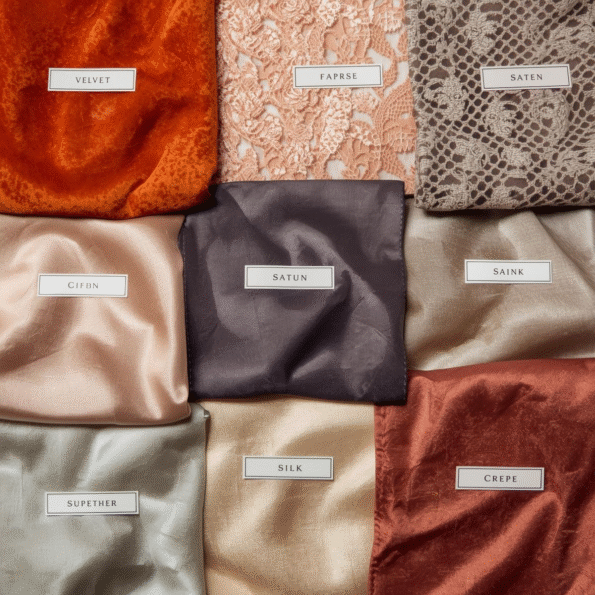
Part 4: A Fabric Encyclopedia – Common Types and Their Uses
Here is a detailed look at some of the most common and distinctive fabrics encountered in fashion and home furnishings.
4.1 Lightweight & Sheer Fabrics
- Chiffon: A lightweight, plain-woven fabric known for its sheer, floating quality. Made from silk, polyester, or rayon. Used in evening wear, scarves, and blouses.
- Georgette: Similar to chiffon but with a crinkly, crepe-like texture, giving it more body and a slightly rough feel. Used in flowing dresses and skirts.
- Voile: A lightweight, plain-woven cotton or cotton-blend fabric with a slightly crisp hand. Used in blouses, summer dresses, and curtains.
- Organza: A stiff, transparent fabric made from silk or synthetic fibers. Used in formal wear, bridal gowns, and decorative elements.
4.2 Medium-Weight Fabrics for Apparel
- Poplin: A strong, plain-weave cotton fabric with a fine horizontal rib. Crisp and smooth, it’s a staple for dress shirts.
- Chambray: Often mistaken for denim, chambray is a plain-weave fabric with a colored warp and a white weft, creating a lighter, softer fabric used in shirts and dresses.
- Denim: A durable cotton twill weave, traditionally with an indigo-blue warp and a white weft. Used for jeans, jackets, and casual wear.
- Gabardine: A tightly woven, durable twill with a distinct diagonal rib. Often wool or cotton, used in tailored trousers, suits, and trench coats.
- Flannel: A soft fabric, typically of wool or cotton, that has been brushed on one or both sides to create a nap. Used in shirts, pajamas, and sheets.
- Jersey: A soft, stretchy knit fabric most famous for its use in T-shirts. Can be made from cotton, wool, or synthetics.
- Corduroy: A “ridged” fabric, where cut pile lines (called “wales”) run parallel to the selvedge. A durable cotton fabric used for casual trousers, jackets, and upholstery.
4.3 Heavyweight & Durable Fabrics
- Canvas: A very strong, durable plain-weave fabric, usually made of cotton. Used for tents, sails, sneakers, and artist canvases.
- Tweed: A rough, woolen fabric, typically woven in a plain, twill, or herringbone pattern. Characterized by its mixed, flecked appearance. Associated with country clothing and iconic for suits and coats.
- Upholstery Fabrics: A broad category including damask (a reversible, patterned fabric), chenille (a soft, fuzzy fabric), and velvet (a cut-pile fabric with a soft, luxurious nap), all designed for durability and aesthetic appeal on furniture.
- Felt: A non-woven fabric made by matting, condensing, and pressing fibers together. Used for crafts, hats, and industrial applications.
4.4 Luxury & Special Occasion Fabrics
- Silk Satin: Known for its high gloss on one side and dull back. The ultimate in luxury for evening gowns and lingerie.
- Velvet: A woven tufted fabric in which the cut threads are evenly distributed, giving a soft, plush pile. Historically made from silk, now often from cotton or synthetics.
- Brocade: A rich, jacquard-woven fabric with an elaborate raised pattern, often using metallic threads. Used in formal wear and upholstery.
- Lace: An elegant, openwork fabric, often used as an accent in wedding dresses, lingerie, and evening wear.
Part 5: The Fabric of Responsibility – Sustainability and Ethics
The global textile industry has a significant environmental and social footprint. The rise of “fast fashion” has exacerbated issues of waste, pollution, and poor labor conditions. Understanding these challenges is crucial for making informed choices.
5.1 Environmental Impact
- Water Consumption: Cotton is a thirsty crop, and the dyeing and finishing processes are incredibly water-intensive.
- Chemical Pollution: The use of pesticides in cotton farming and toxic chemicals in dyeing can contaminate water sources.
- Microplastic Pollution: Washing synthetic garments releases tiny plastic fibers into waterways, entering the food chain.
- Textile Waste: The culture of disposable fashion leads to millions of tons of clothing ending up in landfills each year.
5.2 The Shift Towards Sustainability
Consumers, brands, and innovators are driving change through:
- Organic Farming: Using methods that avoid synthetic pesticides and fertilizers.
- Recycled Fibers: Creating new fabrics from post-consumer waste like plastic bottles (recycled polyester) or old garments (recycled cotton/wool).
- Regenerative Agriculture: Farming practices that improve soil health and biodiversity.
- Closed-Loop Production: As seen with TENCEL™ Lyocell, where chemicals and water are recycled.
- Natural Dyeing: Using dyes derived from plants, minerals, and insects, which are less harmful than synthetic dyes.
- Slow Fashion: A movement favoring quality, durability, and timeless design over fleeting trends.
Part 6: The Future of Fabric – Innovation and Smart Textiles
The future of fabric is intelligent, sustainable, and revolutionary. The line between technology and textile is blurring.
- Smart Textiles (E-textiles): Fabrics that can sense and react to environmental conditions or stimuli from the wearer.
- Wearable Technology: Clothing with integrated sensors to monitor heart rate, muscle activity, or location.
- Phase-Changing Materials (PCMs): Microcapsules in the fabric that absorb, store, and release heat to regulate body temperature.
- Shape Memory Fabrics: Textiles that can return to a pre-programmed shape when heated, useful for adaptive clothing.
- Biodegradable Synthetics: Developing synthetic fibers that can break down safely at the end of their life.
- Biofabricated Materials: Growing textiles in labs from materials like mushroom mycelium (leather alternatives), bacteria (cellulose), or even spider silk proteins.
- 3D Knitting: Creating seamless garments directly from a digital file, minimizing waste in the production process.
Conclusion: A Tapestry Woven Through Time
Fabric is a universe contained within threads. It is a story of biology and chemistry, of art and engineering, of tradition and radical innovation. From the humble, breathable cotton of a summer t-shirt to the life-saving properties of a smart textile in a medical device, fabrics are an indispensable part of the human experience. By understanding their origins, properties, and impacts, we can appreciate the incredible complexity of the textiles that surround us and make choices that support a more sustainable and equitable industry. The next time you feel a fabric, remember—you are touching the result of thousands of years of human ingenuity, a true loom of life.